Cloud & DevOps

Beginner to Mastery

Certified DevOps & MLOps Engineer Program

End-to-end DevOps → Cloud → Kubernetes → MLOps delivery lifecycle

CI/CD pipelines built using GitHub Actions, GitLab CI & Jenkins

GitOps + Declarative delivery for cloud & Kubernetes

Infrastructure provisioning using Terraform & Cloud templates

Group Enrollment with Friends or Colleagues
Certified DevOps & MLOps Engineer Program

Course Duration

250 Hours

Next Batch

23 May 2026

Course Material

Live. Online. Interactive.

Containerization & Kubernetes from fundamentals to production-grade deployments

Serverless & event-driven CI/CD pipelines

Observability, logging & reliability engineering using Prometheus, Grafana & ELK

Containerization & Kubernetes from fundamentals to production-grade deployments

Highlight Certified DevOps & MLOps Engineer Program

KEY HIGHLIGHTS OF CERTIFIED DEVOPS & MLOPS ENGINEER PROGRAM PROGRAM

  • Weekly sessions with industry professionals
  • Dedicated Learning Management Team
  • 250+ hours of hands-on learning experience
  • Over 55 hours of live sessions for real-time interaction
  • Dedicated bridge classes to ensure seamless progression from DevOps and MLOps
  • Learn from Cloud Certified Industry Experts
  • More than 10+ industry-related projects and case studies
  • Personalized mentorship sessions with cloud experts
  • 24*7 Support
  • 1:1 Mock Interviews & Portfolio Building
  • Designed for both working professionals and fresh graduates
  • No-Cost EMI Option available
  • High Demand Skillset with Global Career Opportunities

WHY JOIN CERTIFIED DEVOPS & MLOPS ENGINEER PROGRAM PROGRAM?

Strong DevOps Foundation

DevOps principles taught through real delivery workflows, not theory.

CI/CD & GitOps First Approach

Pipelines, branching strategies, secure CI, and GitOps-based CD.

Infrastructure as Code & Automation

Terraform, cloud templates, configuration management & automation.

Kubernetes & Cloud-Native Engineering

Docker → Kubernetes → Helm → GitOps deployments.

Production Monitoring & Reliability

Observability, logging, alerting & troubleshooting like real SRE teams.

Future-Ready DevOps + MLOps

AI pipelines, GPU orchestration & ML production operations

UPCOMING BATCH:

23 May 2026

SkillzRevo

SkillzRevo Solutions

30 MINUTE MEETING

Web conferencing details provided upon confirmation.

Corporate Training, Enterprise training for teams

Batch schedule

BatchBatch Type
Online Live Instructor Led SessionFull-Time
Online Live Instructor Led SessionPart-Time

Regional Timings

BatchBatch Type
IST (India Standard Time)09:00 PM–12:00 AM
Bahrain, Qatar, Kuwait, Saudi Arabia06:30 PM–09:30 PM
UAE / Oman07:30 PM–09:00 PM

Certified DevOps & MLOps Engineer Program OVERVIEW

This program is designed to build industry-ready DevOps, Cloud, and MLOps engineers by closely aligning with a real-world enterprise delivery lifecycle. The learning journey begins with strong foundations in DevOps practices and CI/CD pipelines, then progressively moves into Infrastructure as Code (IaC) and Kubernetes engineering. It further covers system monitoring, reliability engineering, and serverless architectures, and finally concludes with advanced topics such as MLOps, AI pipelines, and production-grade machine learning infrastructure, ensuring learners are fully prepared for modern cloud-native and AI-driven environments.

ENROLL NOW, BOOK YOUR SEAT & AVAIL UPTO 30% FEE WAIVER

Enroll Now →

Certified DevOps & MLOps Engineer Program Objectives

The primary objective of this program is to make learners capable of designing, building, deploying, monitoring, and operating production-grade systems across DevOps and CI/CD, Cloud and Kubernetes, observability and reliability engineering, as well as serverless architectures and MLOps pipelines. The focus is on developing deep practical understanding so that learners know when, why, and how to use the right tools in real-world scenarios, rather than just learning what a tool is.

Enroll Now →

Why Learn Certified DevOps & MLOps Engineer Program ?

Industry-Focused Learning

Skills aligned with real enterprise AWS environments and operational best practices.

Real Workflows

Real workflows used by DevOps, SRE & Platform teams.

End-to-End Delivery Ownership

From code commit → CI → CD → infra → monitoring.

Strong Automation & IaC Foundation

Terraform, GitOps & pipeline automation.

Cloud-Native & Kubernetes Expertise

Production-grade deployments & rollbacks.

Observability & Cost Awareness

Monitoring, logging, alerting & optimization.

MLOps & AI Infrastructure Exposure

Rare combination in DevOps programs.

Real-World DevOps Scenarios

Hands-on labs and architecture mapping based on real production use cases.

Role-Based Career Preparation

Prepared for DevOps Engineer, MLOps Engineer, and Infrastructure roles.

Program Advantages

Job-ready DevOps + Cloud + MLOps skills

Strong focus on real production environments

GitOps & Kubernetes-first approach

Covers future DevOps roles, not just current trends

Suitable for product, platform & AI teams

Description

Certified DevOps & MLOps Engineer Program program Certifications

Certified DevOps & MLOps Engineer Program Curriculum

Lecture 1: Numerical Computing with Numpy - Fundamental package for scientific computing with Python.
Lecture 2: Data Manipulation with Pandas - High-performance data structures and data analysis tools.
Lecture 3: Core ML Libraries with scikit-learn | XGBoost - Standard libraries for classical machine learning and gradient boosting.
Lecture 4: Serialization & Config with joblib | pyyaml - Tools for saving model artifacts and managing YAML configuration files.
Lecture 5: Linux & Networking with Linux Foundations | Basic HTTP | DNS | Rest APIs - Essential OS skills and understanding of web communication protocols.
Lecture 6: Version Control with Git & GitHub - Collaborative coding and source code management.
Lecture 7: Testing & Code Quality with pytest - Framework for writing and running unit tests for ML code.
Lecture 8: Experiment Tracking with MLflow | Weights & Biases - Tools to log parameters | metrics | and manage the model registry.
Lecture 9: Data & Model Versioning with DVC | LakeFS - Version control for large datasets and machine learning artifacts.
Lecture 10: Hyperparameter Tuning with optuna - Framework for automated hyperparameter optimization.
Lecture 11: API Development with FastAPI - Modern web framework for building APIs to serve model predictions.
Lecture 12: Containerization with Docker - Packaging applications into containers for consistent deployment.
Lecture 13: Scalable Serving with KServe | Tensorflow Serving - Advanced platforms for deploying and scaling ML models in production.
Lecture 14: Orchestration / Pipelines with Airflow | Kubeflow Pipelines (KFP DSL) | Argo Workflows - Tools to automate and schedule end-to-end ML workflows.
Lecture 15: CI/CD for MLOps with GitHub Actions | GitLab CI - Automating testing and deployment pipelines.
Lecture 16: Cloud Fundamentals with AWS | Azure | GCP - Major cloud platforms for hosting ML workloads.
Lecture 17: Platform & IaC with Kubernetes | Terraform | Pulumi | Crossplane - Container orchestration and Infrastructure as Code for environment management.
Lecture 18: Monitoring & Visualization with Prometheus | Grafana - Tools for tracking system health and real-time performance metrics.
Lecture 19: Observability & Logs with Fiddler | ELK | opensearch - Specialized tools for model performance monitoring and centralized logging.
Lecture 20: Infrastructure Context with CMDB | Topology Mapping - Understanding the relationships between physical and virtual assets.
Lecture 21: Observability Pillars with Prometheus | Grafana | ELK Stack | OpenSearch | Jaeger - Mastering the collection of Metrics | Logs | and Traces.
Lecture 22: Fundamentals with Supervised & Unsupervised Learning - Understanding the different types of learning models applicable to IT data.
Lecture 23: Key Algorithms with Isolation Forests | ARIMA | Prophet | LSTM - Specialized algorithms for Anomaly Detection and Time-Series Forecasting.
Lecture 24: Intelligent Logic with Event Correlation | Noise Reduction | Deduplication - Moving from static thresholds to pattern-based alerting and deduplication.
Lecture 25: Causal AI with Root Cause Analysis (RCA) - Using AI to identify the underlying cause of incidents rather than just symptoms.
Lecture 26: Data Ingestion with Fluentd | Logstash | Vector - Tools for high-performance data shipping from various sources.
Lecture 27: Stream Processing with Apache Kafka | Flink - Processing real-time operational data streams at scale.
Lecture 28: AIOps Platforms with Dynatrace | Datadog | Splunk ITSI | BigPanda - Enterprise platforms that provide out-of-the-box AIOps capabilities.
Lecture 29: Cloud-Native AI with AWS DevOps Guru | Azure Monitor | Google Cloud Operations - Cloud-specific AI tools for monitoring and optimization.
Lecture 30: IT Use Case Training with Log Clustering | Smart Alerting - Training models to group millions of log lines and suppress noisy alerts.
Lecture 31: Experiment Tracking with MLflow - Tracking model versions and performance in catching operational bugs.
Lecture 32: ITSM Integration with ServiceNow | Jira Service Management - Connecting AI insights to ticket management systems.
Lecture 33: Collaboration (ChatOps) with Slack | Microsoft Teams - Real-time delivery of AI insights to engineering teams.
Lecture 34: Event-Driven Automation with Ansible Rulebooks | StackStorm | Argo Events - Automating responses to specific events detected by AI.
Lecture 35: Closed-Loop Remediation with Self-Healing Scripts - Automatic execution of playbooks to resolve issues (e.g. restarting services).
Lecture 36: Scalability with Kubernetes | KEDA - Managing AIOps across global clusters and event-driven autoscaling.
Lecture 37: FinOps Integration with Cost Optimization Models - Using AI to predict and optimize cloud infrastructure spending.
Lecture 38: Prompt Engineering with Few-shot | Chain-of-Thought | ReAct - Mastering advanced techniques to guide LLM reasoning and output quality.
Lecture 39: Model Selection with Llama 3 | Mistral | GPT-4 | Gemini - Understanding the trade-offs between open-source and proprietary models.
Lecture 40: Vector Databases with Pinecone | Milvus | Weaviate | ChromaDB - Storing and retrieving high-dimensional embeddings for contextual data.
Lecture 41: Orchestration Frameworks with LangChain | LlamaIndex - Building complex chains that connect LLMs with external data sources.
Lecture 42: Fine-Tuning with LoRA | QLoRA | PEFT - Techniques for specializing models on domain data with minimal compute.
Lecture 43: Quantization with GGUF | EXL2 | AWQ - Reducing model size and memory requirements for faster inference.
Lecture 44: Semantic Evaluation with Ragas | DeepEval | Promptfoo - Using automated frameworks and "LLM-as-a-judge" to score outputs.
Lecture 45: Testing & Reliability with Deterministic Tests | Keyword Checks - Implementing standard software tests for non-deterministic model outputs.
Lecture 46: Inference Servers with vLLM | Text Generation Inference (TGI) | Ollama - High-throughput engines for serving LLMs in production environments.
Lecture 47: GPU Management with NVIDIA CUDA | Triton Inference Server - Optimizing GPU utilization and managing specialized hardware drivers.
Lecture 48: Observability & Tracing with LangSmith | Arize Phoenix - Debugging and visualizing the step-by-step execution of LLM chains.
Lecture 49: Prompt Versioning with LiteLLM | Portkey - Managing multiple model providers and versioning prompts as code.
Lecture 50: Safety & Compliance with NeMo Guardrails | Guardrails AI - Real-time filtering of inputs and outputs to prevent hallucinations and bias.
Lecture 51: Security with Prompt Injection Defense | PII Scrubbing - Protecting against adversarial attacks and ensuring data privacy.
Lecture 52: Cost & Usage with Token Tracking | Rate Limiting - Monitoring API consumption and managing infrastructure costs.
Lecture 53: Feedback Loops with Human-in-the-loop | Reinforcement Learning - Collecting user feedback to improve model performance over time.

Certified DevOps & MLOps Engineer Program Skills Covered

DevOps Foundations & Delivery Models
Git, GitOps & CI Systems
CI/CD Pipeline Engineering
Infrastructure as Code & Configuration Management
Docker, Kubernetes, Helm & GitOps CD
Observability, Logging & Reliability Engineering
Serverless & Event-Driven Systems
MLOps Pipelines & Model Lifecycle
AI Infrastructure & Production ML Ops

Certified DevOps & MLOps Engineer Program Tools Covered

Logo 0
Logo 1
Logo 2
Logo 3
Logo 4
Logo 5
Logo 6
Logo 7
Logo 8
Logo 9
Logo 10
Logo 11
Logo 12
Logo 13
Logo 14
Logo 15
Logo 16
Logo 17

Certified DevOps & MLOps Engineer Program Program Benefits

Certified DevOps & MLOps Engineer Program Program Benefits Illustration

CAREER OPPORTUNITIES AFTER THIS COURSE

Cloud Engineer / Platform Engineer Salary Range

Min

$550,000

Average

$900,000

Max

$1,600,000

Projects

MASTER CLOUD COMPUTING WITH REAL-WORLD PROJECTS

Comprehensive Multi-Cloud Deployment Experience

Industry-Aligned Advanced Scenarios

Build Enterprise-Grade Production Solutions

Cloud Infrastructure & Architecture
NO. OF PROJECTS: 8

DevOps & Automation
NO. OF PROJECTS: 7
Security, Compliance & FinOps
NO. OF PROJECTS: 5

Capstone Projects of this Program

Enterprise Multi-Cloud Infrastructure Deployment

Design and deploy enterprise-scale applications across AWS, Azure, and GCP using Infrastructure as Code with advanced networking and security configurations.

Advanced CI/CD Pipeline with Multi-Stage Deployment

Build comprehensive CI/CD pipelines using Jenkins and GitHub Actions with multi-environment deployments, automated testing, and rollback strategies.

Production-Grade Kubernetes Cluster Architecture

Deploy, scale, and manage production-ready microservices using Kubernetes with Helm charts, service mesh, and advanced monitoring.

Cloud Security & Compliance Framework Implementation

Implement comprehensive security controls including IAM policies, encryption, network security, and compliance frameworks (GDPR, HIPAA, ISO 27001).

Multi-Cloud Terraform Infrastructure Automation

Automate cloud resource provisioning and management using Terraform across AWS, Azure, and GCP with state management and modular architecture.

Enterprise Disaster Recovery & High Availability Solution

Design and implement enterprise-grade disaster recovery strategy with automated backup, failover mechanisms, and business continuity planning.

FinOps: Cloud Cost Optimization & Management Platform

Analyze and optimize cloud spending using FinOps principles, automated cost management tools, and resource right-sizing strategies.

Serverless Application Architecture with Event-Driven Design

Build scalable event-driven serverless applications using AWS Lambda, Azure Functions, and GCP Cloud Functions with API Gateway integration.

Hybrid Cloud Architecture Integration

Design and implement hybrid cloud solutions connecting on-premises infrastructure with cloud platforms using VPN, Direct Connect, and ExpressRoute.

Advanced Monitoring, Observability & SRE Implementation

Implement comprehensive monitoring and observability solutions using Grafana, Prometheus, and CloudWatch with SRE best practices.

Job Obligation After This Course

WE CAN APPLY FOR JOBS IN

Design, implement, and maintain robust CI/CD pipelines for automated build and deployment

Manage GitOps-based deployment workflows for scalable and reliable releases

Provision, manage, and optimize cloud infrastructure using Terraform (IaC)

Deploy, operate, and scale Kubernetes workloads in production environments

Implement monitoring, logging, and alerting for system observability and reliability

Design and manage serverless and event-driven architectures

Support and operate ML pipelines and AI infrastructure in production

Troubleshoot, debug, and resolve production incidents to ensure high availability and performance

Companies Hiring for this Course

Logo 0
Logo 1
Logo 2
Logo 3
Logo 4
Logo 5
Logo 6
Logo 7
Logo 8
Logo 9
Logo 10
Logo 11
Logo 12
Logo 13
Logo 14
Logo 15
Logo 16
Logo 17
Logo 18
Logo 19
Logo 20
Logo 21
Logo 22
Logo 23
Logo 24
Logo 25
Logo 26
Logo 27
Logo 28
Logo 29
Logo 30
Logo 31
Logo 32
Logo 33
Logo 34
Logo 35
Logo 0
Logo 1
Logo 2
Logo 3
Logo 4
Logo 5
Logo 6
Logo 7
Logo 8
Logo 9
Logo 10
Logo 11
Logo 12
Logo 13
Logo 14
Logo 15
Logo 16
Logo 17
Logo 18
Logo 19
Logo 20
Logo 21
Logo 22
Logo 23
Logo 24
Logo 25
Logo 26
Logo 27
Logo 28
Logo 29
Logo 30
Logo 31
Logo 32
Logo 33
Logo 34
Logo 35
Logo 36
Logo 37
Logo 0
Logo 1
Logo 2
Logo 3
Logo 4
Logo 5
Logo 6
Logo 7
Logo 8
Logo 9
Logo 10
Logo 11
Logo 12
Logo 13
Logo 14
Logo 15
Logo 16
Logo 17
Logo 18
Logo 19
Logo 20
Logo 21
Logo 22
Logo 23
Logo 24
Logo 25
Logo 26
Logo 27
Logo 28
Logo 29
Logo 30
Logo 31
Logo 32
Logo 33
Logo 34
Logo 35
Logo 36
Logo 37

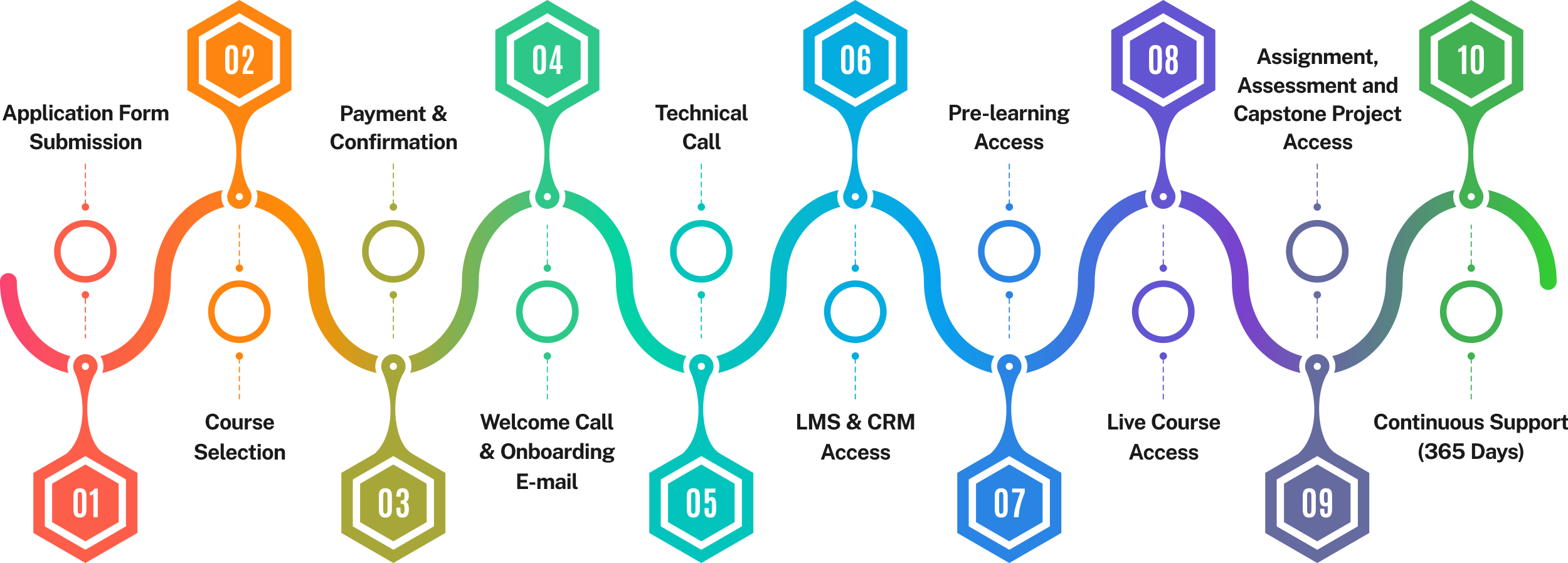
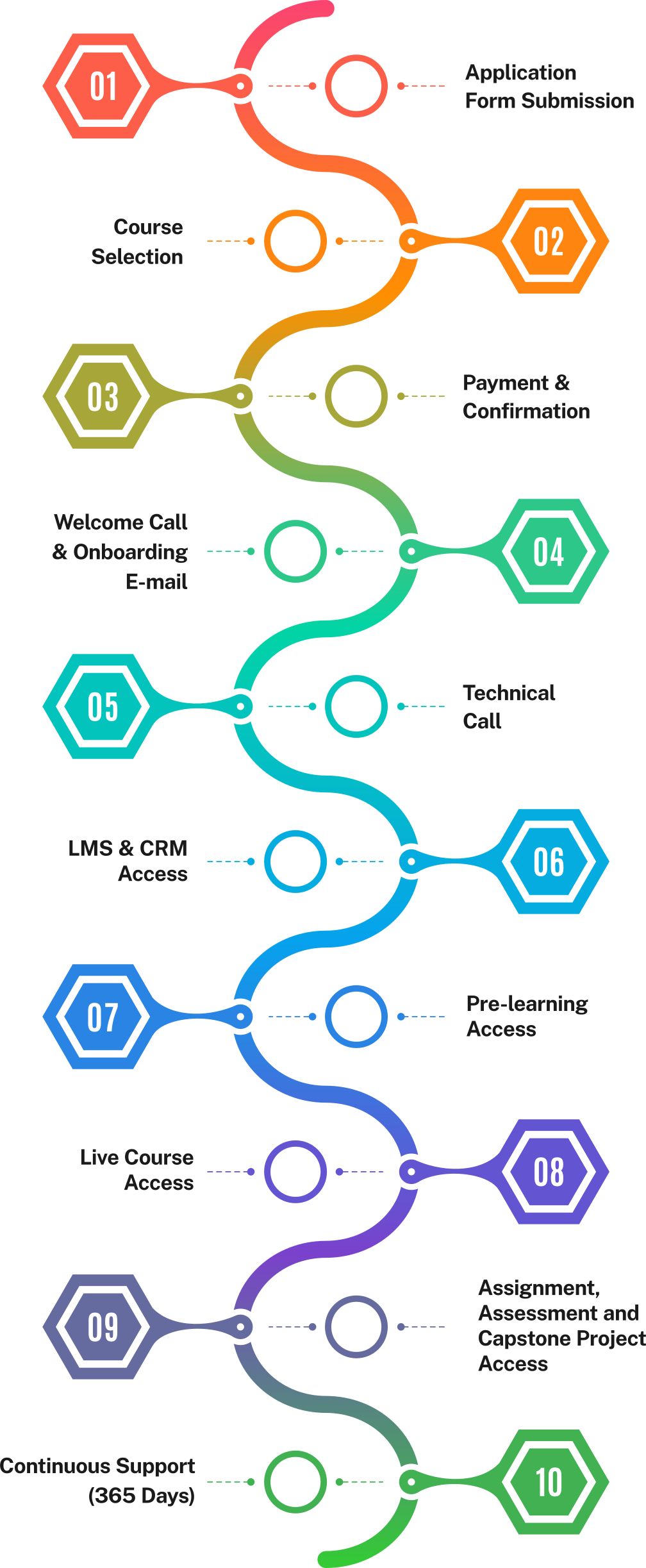
Admission Process

The application process consists of three simple steps. An offer of admission will be made to selected candidates based on the feedback from the interview panel. The selected candidates will be notified over email and phone, and they can block their seats through the payment of the admission fee.

Course Fees & Financing

Course Fees

Upto

30%

Off

In USD

$649

In INR

59,999

Inclusive of All Taxes

Enroll Now →
Payment Partners

We partnered with financing companies to provide competitive finance options at 0% interest rate with no hidden costs.

Payment Tool 1
Payment Tool 2
Payment Tool 3
Payment Tool 4
Payment Tool 5
Payment Tool 6

UPCOMING BATCHES/PROGRAM COHORTS

BatchDateTime (IST)Batch Type
Weekend Online Live Sessions23 May 2026Saturday & SundayBatch 1
Weekend Online Live SessionsVery SoonSaturday & SundayBatch 2

COMPARISON WITH OTHERS

FeatureOur CourseCOMPETITOR ACOMPETITOR B
FoundationsDevOps foundations mapped to real delivery workflows (Chapter 1)Theory-based DevOps conceptsGeneral terminology overview
CI/CDMulti-tool pipelines: GitHub Actions, GitLab CI, Jenkins (Chapter 3)Single-tool CI demosBasic pipeline theory
GitOpsDedicated GitOps + declarative CD (Chapter 2 & 5)Rarely coveredMissing or brief mention
IaCTerraform basics → advanced → cloud templates (Chapter 4)Only basic TerraformIntroduction to IaC only
Config ManagementAnsible / Puppet / Chef comparison with workflowsTool overview onlySingle tool focus
ContainersDocker → Kubernetes → Helm → GitOps CD (Chapter 5)Docker + basic K8sIntroduction to containers
ObservabilityPrometheus, Grafana, ELK with troubleshooting (Chapter 6)Monitoring overviewBasic logging setup
ServerlessCI/CD for serverless & event-driven systems (Chapter 7)Optional topicNot covered
MLOpsFull MLOps lifecycle + CI/CT/CD (Chapter 8)Not includedMissing
AI InfraGPU orchestration, ML monitoring, drift detection (Chapter 9)Completely missingN/A
OutcomeDevOps + Cloud + MLOps Engineer readinessEntry-level DevOps onlyGeneral IT operations knowledge

Official Partnership Recognition

Proud to be a Recognised Skilling Partner of IT-ITeS SSC Nasscom
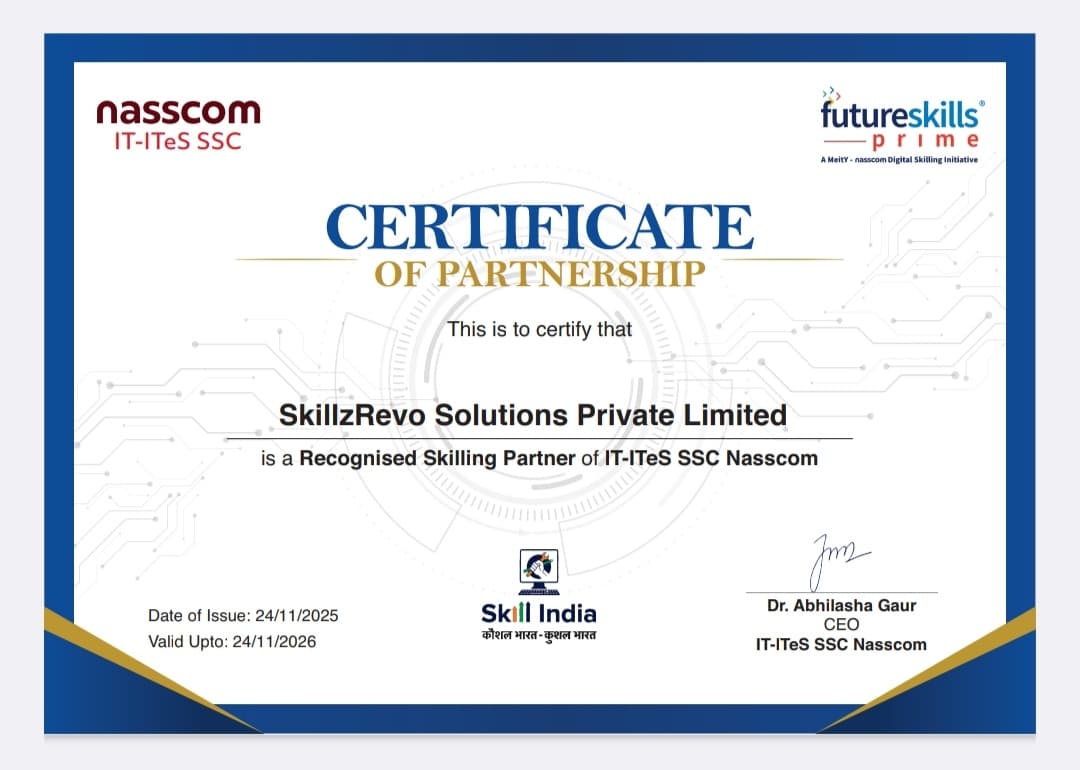
Partnership Certificate
Verified

Certificate of Partnership

SkillzRevo Solutions Private Limited

Partnership Details

Organization

SkillzRevo Solutions Private Limited

Recognition Status

Recognised Skilling Partner

Certifying Authority

IT-ITeS SSC Nasscom

Validity Period

24/11/2025 - 24/11/2026

FutureSkills Prime Initiative

A MeitY - Nasscom Digital Skilling Initiative empowering professionals with cutting-edge IT skills

Active Partnership

10+

Year Partnership

100%

Certified

Committed to Excellence in Digital Skilling

As a recognized skilling partner, we are dedicated to delivering world-class IT training and development programs aligned with industry standards and government initiatives.

Skill IndiaIT-ITeS SectorNasscom Certified

Frequently Asked Questions