Cybersecurity

Beginner to Mastery

Advanced Professional Program in Cybersecurity, Threat Management & AI Security

Comprehensive Cybersecurity & Threat Management Training

SOC, SIEM, Splunk & Incident Response Practicals

Cyber Forensics, System Hardening & Security Configuration

GRC, ISO 27001, Risk Management & Compliance

Group Enrollment with Friends or Colleagues
Advanced Professional Program in Cybersecurity, Threat Management & AI Security

Course Duration

550 Hours

Next Batch

Coming Soon

Course Material

Live. Online. Interactive.

AI Security, LLM Vulnerability Assessment & Responsible AI Governance

Highlight Advanced Professional Program in Cybersecurity, Threat Management & AI Security

KEY HIGHLIGHTS OF ADVANCED PROFESSIONAL PROGRAM IN CYBERSECURITY, THREAT MANAGEMENT & AI SECURITY PROGRAM

  • Comprehensive Cybersecurity & Threat Management Curriculum
  • Dedicated Learning & Practical Training Support
  • 550 Hours of Structured Learning Experience
  • 200 Hours of Live Sessions Across the Program
  • 200 Hours of Recorded Learning Sessions
  • Pre-Learning Material: 50 Hours
  • Learn Cybersecurity, SOC, SIEM & Cyber Forensics
  • Hands-On Labs, Case Studies & Capstone Activities
  • Practical Exposure to Industry-Relevant Security Tools
  • Learn Incident Response & Threat Detection
  • Dedicated Learning Across 14 Modules
  • Designed for Aspiring Cybersecurity Professionals
  • Develop Vulnerability Assessment & Reporting Skills
  • Explore AI Security, LLMs & Prompt Injection
  • Build Knowledge of AI Agent, RAG & MCP Security
  • Understand GRC, ISO 27001 & Risk Management
  • Strengthen Problem-Solving & Security Analysis Skills

WHY JOIN ADVANCED PROFESSIONAL PROGRAM IN CYBERSECURITY, THREAT MANAGEMENT & AI SECURITY PROGRAM?

Comprehensive Cybersecurity Learning

Build a strong foundation in cybersecurity fundamentals, ethical hacking, web application security, network VAPT, security operations, cyber forensics, GRC, and AI security.

Practical, Hands-On Training

Strengthen your practical understanding through guided demonstrations, vulnerability assessment exercises, network security labs, Splunk log analysis, system hardening, forensic investigations, and capstone activities.

Advanced Threat Management & AI Security

Explore SOC operations, SIEM, MITRE ATT&CK, incident response, cyber forensics, LLM vulnerabilities, prompt injection, AI agent security, and AI-enabled defence.

Career-Oriented Skill Development

Develop foundational skills relevant to cybersecurity analysis, SOC operations, VAPT, incident response, cyber forensics, network security, GRC, and emerging AI security roles.

UPCOMING BATCH:

Upcoming Batch — Date to Be Announced

SkillzRevo

SkillzRevo Solutions

30 MINUTE MEETING

Web conferencing details provided upon confirmation.

Corporate Training, Enterprise training for teams

Batch schedule

BatchBatch Type
Online Live Instructor Led SessionFull-Time
Online Live Instructor Led SessionPart-Time

Regional Timings

BatchBatch Type
IST (India Standard Time)09:00 PM–12:00 AM
Bahrain, Qatar, Kuwait, Saudi Arabia06:30 PM–09:30 PM
UAE / Oman07:30 PM–10:30 PM

Advanced Professional Program in Cybersecurity, Threat Management & AI Security OVERVIEW

Build your expertise with our Advanced Professional Program in Cybersecurity, Threat Management & AI Security, a 550-hour live online cybersecurity course covering ethical hacking, web application security, network VAPT, SOC operations, SIEM and Splunk implementation, incident response, and cyber forensics. Explore GRC, ISO 27001, risk management, and compliance, along with AI security topics including LLM vulnerabilities, prompt injection, AI agent, RAG and MCP security, and responsible AI governance. Practise with industry-relevant tools such as Burp Suite, Nmap, Metasploit, SQLmap, Wireshark, Splunk, and Nessus through hands-on labs, case studies, and capstone activities.

ENROLL NOW, BOOK YOUR SEAT & AVAIL UPTO 30% FEE WAIVER

Enroll Now →

Advanced Professional Program in Cybersecurity, Threat Management & AI Security Objectives

The Advanced Professional Program in Cybersecurity, Threat Management & AI Security aims to develop learners' foundational knowledge and practical understanding of cybersecurity, ethical hacking, threat management, and emerging AI security. The program focuses on cybersecurity fundamentals, web application security, network concepts, vulnerability assessment and penetration testing, cryptography, and security configuration. It also covers Security Operations Center (SOC) fundamentals, SIEM and Splunk implementation, security log analysis, incident handling, incident response, configuration audits, and system hardening. Learners will explore cyber forensics, digital evidence collection, memory and disk analysis, security investigation, and reporting. The program further introduces ISO 27001, information security management, Governance, Risk & Compliance (GRC), risk assessment, cyber law, and data protection. Through guided demonstrations, controlled lab exercises, security assessments, case studies, and capstone activities, learners will develop an understanding of identifying vulnerabilities, analysing security events, investigating incidents, documenting findings, and recommending mitigation strategies. The final module explores AI/ML security, LLM vulnerabilities, prompt injection, adversarial machine learning, AI agent security, RAG and MCP security, and responsible AI governance. By the end of the program, learners will have a structured foundation for understanding modern cybersecurity threats and pursuing further development in cybersecurity operations, technical security assessment, incident response, digital forensics, and AI security.

Enroll Now →

Why Learn Advanced Professional Program in Cybersecurity, Threat Management & AI Security ?

High Demand for Cybersecurity Professionals

Develop foundational skills to understand evolving cyber threats, identify vulnerabilities, and help organisations strengthen their networks, applications, systems, and digital assets.

Comprehensive Skill Development

Explore cybersecurity fundamentals, ethical hacking, web application security, network VAPT, SOC, SIEM, Splunk, incident response, cyber forensics, cloud security, GRC, ISO 27001, and AI security.

Hands-On Practical Training

Practise security assessment techniques using tools and platforms such as Burp Suite, Nmap, Metasploit, SQLmap, Wireshark, Splunk, Nessus, Autopsy, and FTK Imager in controlled lab environments.

Real-World Security Applications

Learn through vulnerability assessments, threat detection, security log analysis, incident investigations, system hardening, compliance case studies, risk assessment, and capstone projects. Explore AI vulnerabilities, prompt injection, AI agent security, and responsible AI governance.

Program Advantages

Covers Cybersecurity Fundamentals, Ethical Hacking, Web Application Security, Network VAPT, SOC, SIEM, Cyber Forensics, GRC, and AI Security.

Practical Labs, Security Assessments, Case Studies, and Capstone Projects help learners apply cybersecurity concepts in controlled environments.

Covers Industry-Relevant Security Standards and Frameworks, including ISO 27001, ISO 27002, NIST Cybersecurity Framework, MITRE ATT&CK, and OWASP security guidance.

Gain Practical Exposure to Security Tools and Platforms such as Burp Suite, Nmap, Metasploit, SQLmap, Wireshark, Splunk, Nessus, Autopsy, and FTK Imager.

Develop Foundational Skills in Vulnerability Assessment, Penetration Testing, Threat Detection, Incident Response, Security Log Analysis, and Security Reporting.

Explore Network Security, Cloud Security Fundamentals, Active Directory Security, Security Configuration, and System Hardening to understand security challenges across different environments.

Learn to Identify Security Weaknesses, Analyse Security Events, Investigate Incidents, Assess Risks, Document Findings, and Understand Remediation Strategies.

Explore Emerging AI Security Challenges, including LLM Vulnerabilities, Prompt Injection, Adversarial Machine Learning, AI Agent Security, RAG, MCP, and Responsible AI Governance.

Build Knowledge Relevant to Cybersecurity Career Pathways through Structured Training, Assignments, Assessments, Practical Exercises, and Project-Based Learning.

Description

Advanced Professional Program in Cybersecurity, Threat Management & AI Security program Certifications

Advanced Professional Program in Cybersecurity, Threat Management & AI Security Curriculum

Lecture 1: Introduction to Ethical Hacking: What is hacking, computer security threats, goals of ethical hacking, skills and tools required for ethical hackers, phases of ethical hacking, and ethical hacking process demonstrations.
Lecture 2: Information Gathering & Reconnaissance: Information gathering concepts, footprinting, reconnaissance, and active and passive scanning.
Lecture 3: Cybersecurity Threats & Risk: Confidentiality, Integrity and Availability (CIA), threats, vulnerabilities, threat actors, risk concepts, spoofing, tampering, repudiation, information breach, denial of service (DoS), elevation of privilege, and the GitHub DDoS attack case study.
Lecture 4: Common Cyberattacks: Common cyberattacks, including denial of service (DoS), phishing, and ransomware.
Lecture 5: Information Security Principles: Introduction and importance of information security, purpose, audience and scope, CIA security objectives, authority and access control, data classification, security awareness, responsibilities, rights and duties, and information security principles.
Lecture 6: Data Security Fundamentals: Introduction to data security, encryption, data erasure, data masking, data resiliency, data security strategy, physical security of servers and user devices, access management, access controls, and backups.
Lecture 7: Web Application Fundamentals: Basics of web applications, HTTP/HTTPS, cookies, sessions, authentication mechanisms, and an overview of the OWASP Top 10.
Lecture 8: Web Security Lab Setup: Installing and configuring DVWA, WebGoat and Burp Suite, and introduction to common testing platforms such as OWASP Juice Shop and web application challenges.
Lecture 9: Web Reconnaissance & Enumeration: Understanding target applications, directory and file enumeration using DirBuster and Gobuster, endpoint discovery, and technology identification using Wappalyzer and WhatWeb.
Lecture 10: Authentication & Session Management: Testing login mechanisms, credential brute-forcing demonstrations using Hydra, exploiting weak sessions, and hands-on exercises with DVWA.
Lecture 11: Cross-Site Scripting (XSS): Reflected and stored XSS, input sanitization issues, and practical demonstrations using WebGoat and OWASP Juice Shop.
Lecture 12: SQL Injection: Error-based, blind and time-based SQL injection, SQL vulnerability testing using SQLmap, and hands-on challenges.
Lecture 13: File Upload & Path Traversal: Unsecured file uploads, path traversal testing, web shell concepts, and controlled hands-on exercises with DVWA.
Lecture 14: Business Logic & Access Control: Testing business logic flaws, horizontal and vertical privilege escalation, and access control bypass vulnerabilities.
Lecture 15: Practical Web Application Exploitation: Solving web application challenges, testing simulated applications using OWASP Juice Shop and WebGoat, and practising exploitation techniques in controlled lab environments.
Lecture 16: Vulnerability Reporting & Mitigation: Writing professional vulnerability reports, explaining vulnerabilities and risks, recommending mitigation measures, and discussing case studies.
Lecture 17: Encryption Fundamentals: Remediation planning, introduction to encryption, prerequisites for encryption, how encryption works, and the fundamentals of vulnerability assessment.
Lecture 18: Cryptography, Algorithms & Protocols: Decryption, encryption versus decryption, types of encryption, encryption algorithms and protocols, web application architecture, web application attacks, web server architecture, and web server attacks.
Lecture 19: Information Security Controls: Introduction to information security controls, organizational, people, physical and technological controls, and preventive, corrective and other security control functions.
Lecture 20: Networking Protocol Fundamentals: OSI concepts, network protocols, ARP, SMTP, ICMP, TCP, and TCP three-way handshaking.
Lecture 21: Network Architecture & Scanning: Computer network architecture, layered architecture, the OSI model, TCP/IP, network scanning, enumeration, and common network threats and attacks.
Lecture 22: Packet Inspection & Network Threats: Packet inspection, deep packet inspection, Intrusion Detection Systems (IDS), Intrusion Prevention Systems (IPS), IP security, and ICMP attacks.
Lecture 23: Network Protocol & Availability Security: TCP and UDP security, DoS and DDoS attacks, SSL/TLS, confidentiality, integrity, availability, authorization, authentication, identification, non-repudiation, security control types, access control, and security vulnerability management.
Lecture 24: Network Devices & Firewall Configuration: Network devices including hubs, switches, routers, bridges, gateways, modems, repeaters and access points; network device configuration, network configuration tools, firewalls, and firewall configuration.
Lecture 25: Introduction to Network VAPT: Understanding VAPT, VAPT methodology, information gathering, scanning, exploitation, reporting, setting up the lab environment, and introduction to VulnHub.
Lecture 26: Network Reconnaissance & Enumeration: Passive reconnaissance, active scanning using Nmap, service enumeration, identifying open ports, and vulnerability discovery.
Lecture 27: Service Exploitation Fundamentals: Exploiting misconfigured services such as FTP and SMB, privilege escalation fundamentals, and solving a beginner-level VulnHub machine.
Lecture 28: Network & Web Exploitation: Attacking web servers and applications, SQL injection, command injection, and exploiting vulnerable web servers in VulnHub labs.
Lecture 29: Practical Exploitation & Common Weaknesses: Simulating attacks using Metasploit and Burp Suite, exploiting common weaknesses such as default credentials and outdated software, and practising in controlled environments.
Lecture 30: Post-Exploitation Concepts: Maintaining access, credential-dumping concepts, lateral movement, and hands-on exercises with intermediate-level VulnHub machines.
Lecture 31: End-to-End VAPT & Reporting: Conducting an end-to-end VAPT simulation on a complex VulnHub machine, documenting vulnerabilities, preparing reports, and recommending mitigation measures.
Lecture 32: ISO Standards & ISMS: Introduction to ISO standards, overview of ISO 27001, key components of an Information Security Management System (ISMS), the relationship with ISO 27002, and objectives of implementing ISO standards.
Lecture 33: Cybersecurity Regulations & Information Security Policies: Security misconfiguration, active and passive attacks, cybersecurity regulations, roles of international law, the state and private sector in cyberspace, cybersecurity standards, the Indian cyberspace, National Cyber Security Policy 2013, information security policy elements, COSO, COBIT, ITIL, NIST, NSA, ISO, the IT Act, copyright, patent law, and intellectual property rights.
Lecture 34: Security Policy Management & Frameworks: Cybersecurity landscape, cybersecurity policy management, the security policy ecosystem, policy design and management, cybersecurity frameworks, the ISMS environment, frameworks, and ISO 27001.
Lecture 35: Compliance & Audits: Importance of regulatory compliance, internal and external audits, audit planning, execution and reporting, and preparation for ISO 27001 certification.
Lecture 36: Governance, Risk & Compliance (GRC): Introduction to GRC frameworks, alignment with business objectives, benefits of GRC implementation, and case studies on effective GRC practices.
Lecture 37: Risk Assessment & Management: Introduction to risk assessment, risk identification, risk assessment models, risk assessment and mitigation, prevention, and the role and importance of risk assessment.
Lecture 38: AI/ML Security Foundations: Security-relevant concepts of machine learning and Large Language Models (LLMs), the AI threat landscape, and the OWASP Top 10 for LLM Applications.
Lecture 39: LLM Security Testing: Direct and indirect prompt injection, jailbreaks, sensitive-data disclosure, insecure output handling, and hands-on security testing in a deliberately vulnerable LLM application lab.
Lecture 40: Adversarial Machine Learning: Adversarial ML concepts, evasion, data poisoning, model theft and model inversion, security guardrails, input/output validation, rate limiting, and monitoring.
Lecture 41: AI Agent, RAG & MCP Security: Security of retrieval- and tool-connected AI assistants, prompt injection, document access boundaries, tool poisoning, excessive tool permissions, secret exposure, output validation, audit logging, controlled security assessments, and regression testing.
Lecture 42: AI Governance & Compliance: NIST AI Risk Management Framework, EU AI Act, ISO/IEC 42001, data protection implications for AI systems, responsible AI, and shadow-AI policy.
Lecture 43: Information Security Management & Responsibilities: Information security hierarchy and responsibilities of the Board of Directors, CIO, CISO, CEO, system architects, system engineers, security directors, system administrators, security analysts, IS auditors and database administrators. Importance and elements of information security policies, including purpose, audience, CIA objectives, encryption policies and data backup policies.
Lecture 44: Introduction to SOC: Introduction to the Security Operations Center and its importance, in-house, managed and virtual SOCs, SOC architecture, SIEM, EDR, threat intelligence tools, key SOC roles, and the role of SOC teams in cyber defence.
Lecture 45: Indicators of Compromise (IOCs) & Indicators of Attack (IOAs): Differences between IOCs and IOAs, identifying file hashes, IP addresses, domains and log-based indicators, understanding attack patterns and suspicious behaviours, and real-world examples.
Lecture 46: Tactics, Techniques & Procedures (TTPs): Introduction to TTPs, the MITRE ATT&CK framework, correlating TTPs with IOCs and IOAs, mapping an attack lifecycle using TTPs, and practical exercises with sample data.
Lecture 47: Incident Handling & Response Lifecycle: Types of security incidents, incident impact, analysing alerts, logs and network flows, phases of incident handling, and the incident response lifecycle.
Lecture 48: Firewall Security & Incident Response: Purpose of firewalls, DMZ concepts, troubleshooting Cisco IOS firewalls and routers, antivirus and antispam solutions, and incident response activities including identification, recording, response, communication, containment, classification and investigation.
Lecture 49: Unauthorized Access & Network Traffic Filtering: Unauthorized access incidents, network traffic filtering, Network Address Translation (NAT), and Virtual Private Networks (VPNs).
Lecture 50: IDS & Security Device Configuration: Intrusion Detection and Prevention (IDP/IDS) concepts, Cisco IOS firewall and IDS configuration, initializing security devices, configuring audit rules, and verifying configurations.
Lecture 51: IPS, SNMP & Network Security Configuration: IPS configuration and tuning, SNMP configuration, and configuration of security devices.
Lecture 52: Patch Management: Patch management fundamentals and Windows Server Update Services (WSUS).
Lecture 53: Introduction to SIEM & Splunk: Understanding SIEM, its key components and benefits, Splunk architecture, and setting up the Splunk environment through installation and configuration.
Lecture 54: Security Log Collection & Data Onboarding: Collecting logs from web servers, applications and systems, parsing and indexing data, and exploring Splunk data inputs and forwarders.
Lecture 55: Splunk Search & Security Log Analysis: Writing Splunk Processing Language (SPL) queries, using search, statistics and visualization tools, identifying anomalies and patterns in logs, and hands-on security log analysis.
Lecture 56: SIEM Use Cases, Dashboards & Alerts: Detecting security incidents such as failed login attempts and brute-force activity, creating dashboards, configuring alerts and reporting, and analysing a security breach scenario using Splunk.
Lecture 57: Secure Configuration & Vulnerability Auditing: Introduction to secure configurations, vulnerability and configuration scanning using Nessus, and hands-on system hardening using HardeningKitty.
Lecture 58: Incident Response & Cyber Forensics Fundamentals: Incident response lifecycle, key components of incident response, the role of cyber forensics in incident response, and an overview of Cyber Triage, Autopsy, FTK Imager and Rkhunter.
Lecture 59: Memory & Disk Forensics: Capturing memory dumps, imaging disks with FTK Imager, fundamentals of artifact analysis, and introduction to disk analysis using Autopsy.
Lecture 60: Rootkit Detection & Linux Investigation: Rootkit detection using Rkhunter, investigating suspicious activity on Linux systems, and live-system analysis using Cyber Triage.
Lecture 61: Digital Forensics Case Study & Investigation Reporting: Investigating a simulated cyber breach, performing an end-to-end incident response workflow, collecting evidence, analysing logs and forensic artifacts, and reporting investigation findings.

Advanced Professional Program in Cybersecurity, Threat Management & AI Security Skills Covered

Cybersecurity Fundamentals & Threat Awareness
Ethical Hacking Methodology & Reconnaissance
Networking Concepts, OSI Model & TCP/IP Protocols
Network Security, Scanning & Service Enumeration
Network Vulnerability Assessment & Penetration Testing (VAPT)
Web Technologies, Web Application Security & OWASP Top 10
Web Application Vulnerability Assessment & Exploitation
Cryptography, Encryption & Secure Communication
Cloud Security, Data Security & Access Management
Active Directory Security & Authentication
Vulnerability Reporting, Risk Analysis & Remediation
Operational Technology (OT/ICS/SCADA) Security
Security Operations Center (SOC) & Threat Intelligence
Security Information and Event Management (SIEM) & Splunk
Incident Handling, Incident Response & Threat Detection
Network Security Devices, Firewalls, IDS/IPS & Configuration
Configuration Auditing, Vulnerability Scanning & System Hardening
Governance, Risk & Compliance (GRC)
ISO 27001:2022, ISO 27002 & Information Security Management Systems (ISMS)
Security Controls, Risk Assessment & Risk Management
Cyber Law, Regulatory Compliance & Data Protection
Digital Forensics, Memory & Disk Analysis
Rootkit Detection, Evidence Collection & Incident Investigation
AI/ML Security & LLM Vulnerability Assessment
Prompt Injection, Jailbreaks & AI Application Security
Adversarial Machine Learning & AI Security Testing
AI Agent, RAG & MCP Security
AI Governance, Responsible AI & Compliance

Advanced Professional Program in Cybersecurity, Threat Management & AI Security Tools Covered

Logo 0
Logo 1
Logo 2
Logo 3
Logo 4
Logo 5
Logo 6
Logo 7
Logo 8
Logo 9
Logo 10
Logo 11

Advanced Professional Program in Cybersecurity, Threat Management & AI Security Program Benefits

Advanced Professional Program in Cybersecurity, Threat Management & AI Security Program Benefits Illustration

CAREER OPPORTUNITIES AFTER THIS COURSE

Junior VAPT Analyst Salary Range

Min

$350,000

Average

$550,000

Max

$900,000

Projects

Projects that you will Work On

Practice Essential Tools

Designed By Industry Experts

Get Real-world Experience

Cyber Security
NO. OF PROJECTS: 3
Ethical Hacking
NO. OF PROJECTS: 5

Capstone Projects of this Program

Wi-Fi Network Penetration Testing

Assess the security of Wi-Fi networks by identifying and exploiting potential vulnerabilities. Learn wireless encryption protocols, perform packet sniffing, and secure wireless networks. Tools: Aircrack-ng, Wireshark, Kali Linux

SQL Injection Testing

Detect and exploit SQL injection vulnerabilities in web applications. Learn SQL injection techniques and implement best practices to secure apps. Tools: SQLmap, Burp Suite, OWASP Juice Shop

Creating a Keylogger

Develop a keylogger to understand malicious software operation. Build malware for educational purposes and learn detection techniques. Tools: Python, Pynput library

Network Sniffing with Wireshark

Capture and analyze network traffic for vulnerabilities. Learn protocol analysis and identify suspicious activities. Tools: Wireshark

Penetration Testing on a Virtual Machine

Simulate attacks in a virtual environment. Hands-on experience with testing tools and documenting findings. Tools: Kali Linux, Metasploit, VirtualBox/VMware

Creating a Simple Firewall

Develop a basic firewall to control network traffic. Filter network traffic and prevent common attacks. Tools: Python, Scapy library

Social Engineering Simulation

Simulate social engineering attacks and develop user education strategies. Craft phishing scenarios and understand human vulnerabilities. Tools: Social-Engineer Toolkit (SET)

IoT Security Analysis

Secure IoT devices by identifying vulnerabilities. Secure firmware and understand IoT attack surfaces. Tools: Shodan, Wireshark, Firmware tools

Intrusion Detection System (IDS)

Monitor traffic and logs to detect cyber threats. Network log analysis and real-time threat detection. Tools: Snort, Suricata, Security Onion

Blockchain Security

Develop secure blockchain apps and smart contracts. Secure DApps and implement safe consensus mechanisms. Tools: Ethereum, Solidity, OpenZeppelin

Job Obligation After This Course

WE CAN APPLY FOR JOBS IN

Conduct vulnerability assessments and penetration tests on networks and web applications.

Identify security weaknesses, analyse vulnerabilities, and recommend remediation measures.

Monitor security alerts, analyse logs, and support incident detection and response.

Analyse security events using SIEM tools such as Splunk and investigate suspicious activities.

Support cybersecurity policies, risk assessments, audits, and GRC compliance activities.

Assess AI application risks, test LLM vulnerabilities, and identify prompt injection issues.

Support AI governance, responsible AI practices, and AI security risk management.

Companies Hiring for this Course

Logo 0
Logo 1
Logo 2
Logo 3
Logo 4
Logo 5
Logo 6
Logo 7
Logo 8
Logo 9
Logo 10
Logo 11
Logo 12
Logo 13
Logo 14
Logo 15
Logo 16
Logo 17
Logo 18
Logo 19
Logo 20
Logo 21
Logo 22
Logo 23
Logo 24
Logo 25
Logo 26
Logo 27
Logo 28
Logo 29
Logo 30
Logo 31
Logo 32
Logo 33
Logo 34
Logo 35
Logo 0
Logo 1
Logo 2
Logo 3
Logo 4
Logo 5
Logo 6
Logo 7
Logo 8
Logo 9
Logo 10
Logo 11
Logo 12
Logo 13
Logo 14
Logo 15
Logo 16
Logo 17
Logo 18
Logo 19
Logo 20
Logo 21
Logo 22
Logo 23
Logo 24
Logo 25
Logo 26
Logo 27
Logo 28
Logo 29
Logo 30
Logo 31
Logo 32
Logo 33
Logo 34
Logo 35
Logo 36
Logo 37
Logo 0
Logo 1
Logo 2
Logo 3
Logo 4
Logo 5
Logo 6
Logo 7
Logo 8
Logo 9
Logo 10
Logo 11
Logo 12
Logo 13
Logo 14
Logo 15
Logo 16
Logo 17
Logo 18
Logo 19
Logo 20
Logo 21
Logo 22
Logo 23
Logo 24
Logo 25
Logo 26
Logo 27
Logo 28
Logo 29
Logo 30
Logo 31
Logo 32
Logo 33
Logo 34
Logo 35
Logo 36
Logo 37

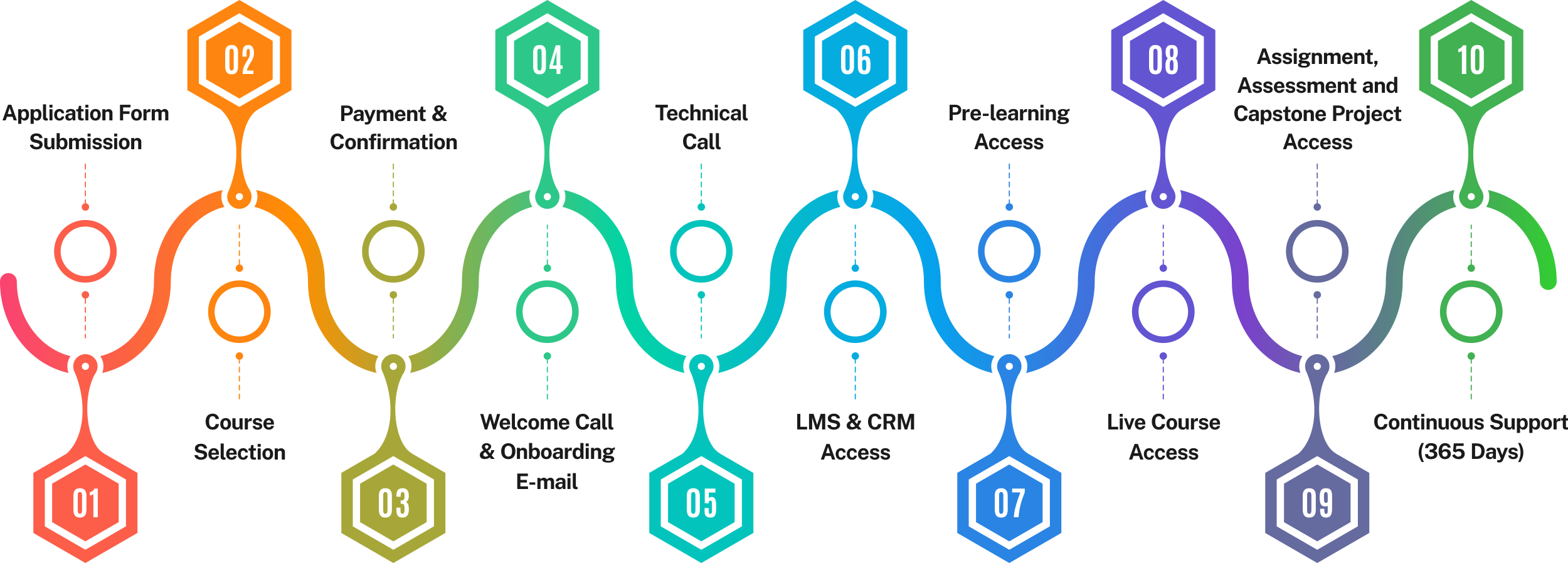
Admission Process

The application process consists of three simple steps. An offer of admission will be made to selected candidates based on the feedback from the interview panel. The selected candidates will be notified over email and phone, and they can block their seats through the payment of the admission fee.

Course Fees & Financing

Course Fees

Upto

30%

Off

In USD

$1,650

In INR

₹1,41,600

Inclusive of All Taxes

Enroll Now →
Flexible Payment Options

We partnered with financing companies to provide competitive finance options at 0% interest rate with no hidden costs.

Flexible payment option 1
Flexible payment option 2
Flexible payment option 3
Flexible payment option 4
Flexible payment option 5
Flexible payment option 6

Trusted payment partners

Payment Partners

  • ICICI Bank logo
  • IndusInd Bank logo
  • Cashfree logo
  • PayU Money logo
  • PayGlocal logo

UPCOMING BATCHES/PROGRAM COHORTS

BatchDateTime (IST)Batch Type
Online Live Instructor Led SessionComing SoonTo Be AnnouncedUpcoming Batch

COMPARISON WITH OTHERS

FeatureOur CourseCOMPETITOR ACOMPETITOR B
Duration8 months (550+ hours)40 hours4–6 months (varies by course)
Learning ModeLive + Recorded Sessions + Hands-on LabsSelf-paced + LiveSelf-paced
Hands-on LabsReal-world simulations (Phishing, Malware, SOC setup, Forensics)LimitedBasic labs
Capstone ProjectsSOC Setup, Phishing Simulation, Forensic AnalysisNo capstone projectsNo capstone projects
Topics CoveredEthical Hacking, Threat Management, Incident Response, VAPT, SIEM, GRC, ComplianceEthical Hacking, Penetration TestingSecurity Basics, Network Security, & Attacks
Industry Tools CoveredSplunk, Nessus, Metasploit, Burp Suite, WiresharkKali Linux, Metasploit, Burp SuiteNone
Placement & Career SupportDedicated LMS, Career Guidance, Mock InterviewsNo career supportNo career support

Official Partnership Recognition

Proud to be a Recognised Skilling Partner of IT-ITeS SSC Nasscom
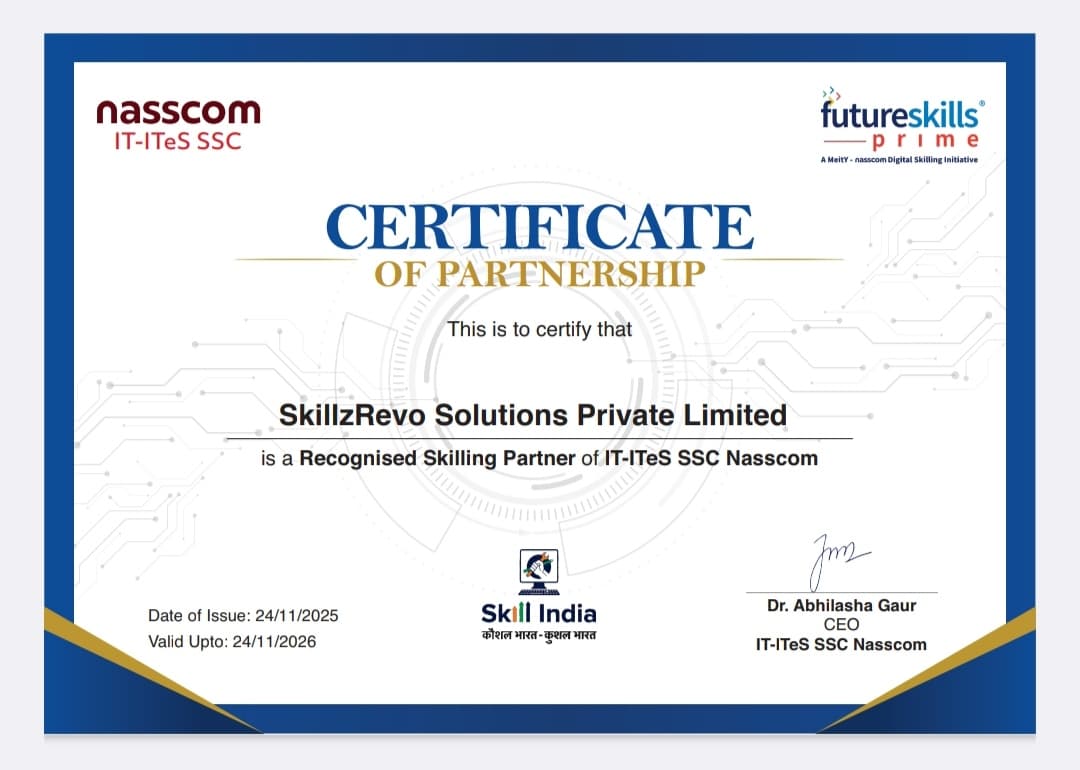
Partnership Certificate
Verified

Certificate of Partnership

SkillzRevo Solutions Private Limited

Partnership Details

Organization

SkillzRevo Solutions Private Limited

Recognition Status

Recognised Skilling Partner

Certifying Authority

IT-ITeS SSC Nasscom

Validity Period

24/11/2025 - 24/11/2026

FutureSkills Prime Initiative

A MeitY - Nasscom Digital Skilling Initiative empowering professionals with cutting-edge IT skills

Active Partnership

10+

Year Partnership

100%

Certified

Committed to Excellence in Digital Skilling

As a recognized skilling partner, we are dedicated to delivering world-class IT training and development programs aligned with industry standards and government initiatives.

Skill IndiaIT-ITeS SectorNasscom Certified

Frequently Asked Questions

Global Presence of Skillzrevo

Our distributed team of experts is working across 6 continents, bringing innovation and expertise to clients worldwide.

Drag the globe to explore our offices and learn more about our global footprint.